The supercomputer that came with a power plant
In 2024, Elon Musk’s xAI built Colossus, a giant AI supercomputer in South Memphis, Tennessee, in what Musk called a record 122 days. Then residents noticed something else going up next to it: gas turbines.
Environmental groups, including the Southern Environmental Law Center, flew over the site with cameras, thermal ones among them, and found 35 methane gas turbines, none fitted with the pollution controls federal rules typically require, together producing enough energy to power about 280,000 homes. The same report notes the area already leads Tennessee in emergency department visits for asthma. After months of protests, the county health department still approved a permit for 15 turbines in July 2025.
That’s the part of AI nobody sees in a chat window. Every answer you get comes from a real building, drawing real electricity, cooled by real water.
So which AI assistant is the greenest? We compared what the big names have actually disclosed. The results are surprising, and so is who’s staying quiet.
Disclosure: We make Grengin, which is mentioned in this article.
The contenders: who’s willing to show their bill?
Before comparing footprints, there’s a more basic question: which companies have actually told us anything? The honest answer is “not many”, and the depth of disclosure varies wildly.
| Assistant | What the company has disclosed | How deep it goes |
|---|---|---|
| Gemini (Google) | Energy, carbon and water for a median text prompt | A full technical paper with methodology, measured on Google’s own fleet |
| Le Chat (Mistral) | Carbon, water and materials per response, plus the total for training | A full lifecycle analysis with France’s ecological transition agency, peer reviewed |
| ChatGPT (OpenAI) | Energy and water for an “average query” | One line in a CEO blog post, no methodology |
| Claude (Anthropic) | No per-query figures published at the time of writing | Only independent estimates exist so far |
That leaves us comparing apples, oranges and a few blank spaces. So for every number below, we’ll say who measured it and how.
Round 1: how much electricity does one answer really use?
For an everyday chat, the answer is “surprisingly little”. Google says a median Gemini prompt uses about as much energy as watching TV for less than nine seconds. But look what happens when the model has to think hard.
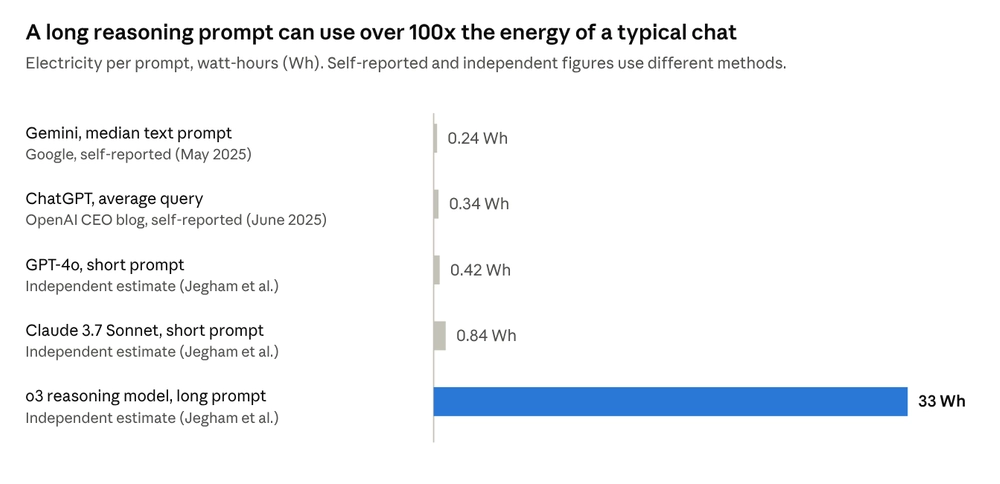
Sources: Google technical paper (Aug 2025), Sam Altman blog (June 2025), Jegham et al., How Hungry is AI? (July 2025 version). The o3 figure is reported as over 33 Wh. Later revisions of the Jegham paper put the most energy-intensive models at over 29 Wh per long prompt.
The surprise: the gap between models is far bigger than the gap between brands. In the same independent study from the University of Rhode Island, o3 and DeepSeek-R1 were the most energy-hungry models tested, using more than 70 times the energy of a small model like GPT-4.1 nano (later revisions put the gap at over 65 times). Meanwhile Claude 3.7 Sonnet ranked highest for eco-efficiency, meaning the best performance for its environmental cost.
Efficiency is also improving fast. Google reports the energy per median Gemini text prompt fell 33 times in a single year.
Round 1 verdict: Gemini has the lowest self-reported number, but the model you choose matters more than the logo on the app.
Round 2: five drops of water, or a shot glass?
Here’s where the comparison gets wild. Look at how far apart the water figures are:
| Assistant | Water per prompt | Carbon per prompt | What’s counted |
|---|---|---|---|
| Gemini | 0.26 mL (about five drops) | 0.03 g CO2e | Running the model in Google’s data centres; excludes training, external networks and your device |
| ChatGPT | About 0.32 mL (one-fifteenth of a teaspoon) | Not disclosed | Not explained |
| Le Chat (Mistral Large 2) | 45 mL | 1.14 g CO2e | One 400-token response, including upstream impacts such as manufacturing the servers; excludes your device |
| Claude | Not disclosed | Not disclosed | Nothing published at the time of writing |

So is Mistral’s chatbot really 170 times thirstier than Gemini? Almost certainly not. Mistral counted far more of the lifecycle, including upstream impacts such as manufacturing the hardware itself. Google measured only the moment your prompt is served.
Even Google admits measurement choices matter: its own paper shows a narrower method that counts only active AI chips would make the same Gemini prompt look 2.4 times smaller (0.10 Wh instead of 0.24 Wh). Critics also note Google left out the indirect water used to generate the electricity in the first place.
Round 2 verdict: Mistral wins on honesty, Google wins on efficiency claims. Paradoxically, the company that measured the most looks the worst on paper.
The bigger picture: tiny prompts, giant grid

One prompt is a few drops of water. Billions of prompts a day is a different story.
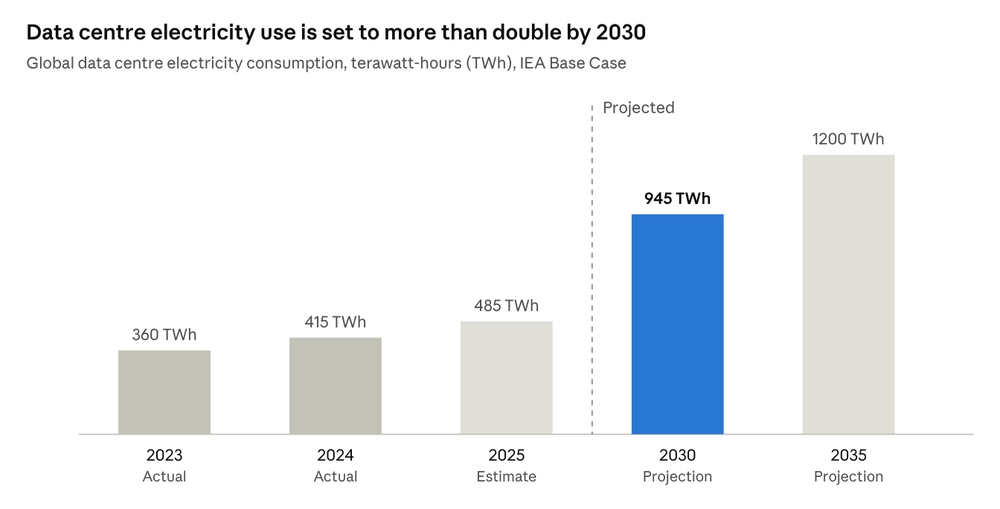
Source: International Energy Agency, Energy and AI (2025) and Key Questions on Energy and AI. 2025 is an estimate; 2030 and 2035 are Base Case projections.
The International Energy Agency says data centres already used about 1.5% of the world’s electricity in 2024, and by 2030 they’ll need slightly more power than all of Japan uses today. AI is the single biggest driver.
The giants feel it too. Google’s 2025 environmental report showed its emissions up 51% from its 2019 baseline, putting its goal of halving emissions by 2030 further out of reach.
This is the efficiency paradox. Each prompt keeps getting cheaper, yet total use grows so fast that the overall footprint still climbs.
Round 3 verdict: no AI assistant is “green” at global scale. The greenest prompt is the one that doesn’t go to waste.
Myth vs fact: what people get wrong about AI and the planet
| Myth | Fact |
|---|---|
| “Every AI prompt boils a bottle of water.” | For a typical text chat, the self-reported figures are a few drops. The real cost comes from scale and from heavy tasks. |
| “All AI chatbots have about the same footprint.” | The model matters more than the brand. A long prompt to a reasoning model can use over 100 times the energy of a simple chat. |
| “The company with the lowest number is the greenest.” | Often it’s the company that measured the least. Lifecycle studies like Mistral’s look worse because they count more. |
| “Efficiency gains will solve the problem.” | Each prompt keeps getting cheaper, but total use is growing faster, so overall energy demand still rises. |
| “There’s nothing a single company can do.” | How your team uses AI, which models it picks and what you ask vendors all make a measurable difference. |
The green AI playbook: five habits that actually move the needle
You don’t need to quit AI to use it responsibly. The biggest lever isn’t which brand you pick. It’s how your team uses it.

- Match the model to the job. A huge reasoning model for a one-line email is like taking a truck to buy milk. Mistral’s study found that impacts are roughly proportional to model size, so lighter models for everyday tasks add up to big savings.
- Save “thinking mode” for hard problems. Reasoning models can burn many times more energy per answer, as the Round 1 chart shows. Use them for complex analysis, not for reformatting a table.
- Ask for shorter answers. Mistral measured its footprint per 400-token response; every extra paragraph you don’t need has a cost.
- Stop the regenerate habit. A clearer first prompt beats hitting “regenerate” five times.
- Skip AI where a simple tool works. A calculator, a search or a template doesn’t need a large language model.
What good looks like: a greener AI checklist for companies
Individual habits help. Company-wide defaults help far more, because they apply to every prompt automatically.
| Area | Business as usual | Greener practice |
|---|---|---|
| Default model | The biggest model for everything | A lighter model by default, with heavier ones available when needed |
| Model choice | One vendor, whatever it offers | Several approved models, so teams can pick the right size for the task |
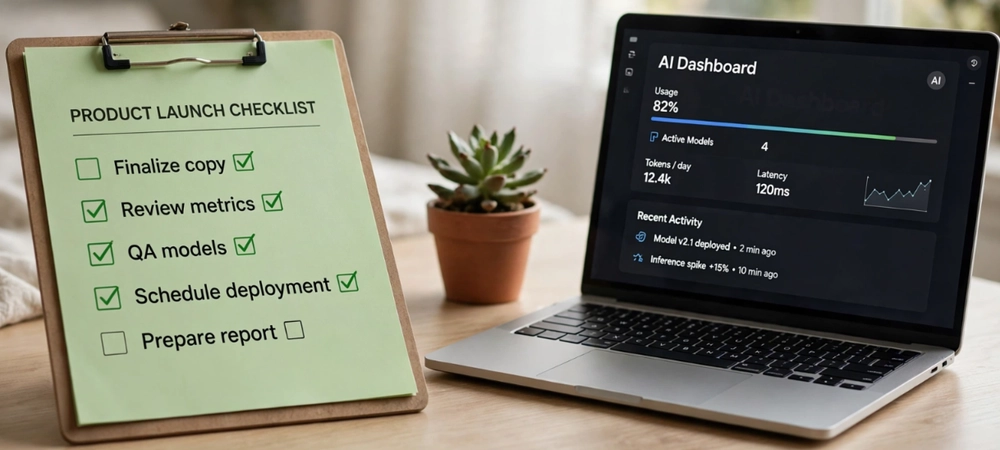
| Visibility | No idea how much AI is used | Usage tracked in one place, so you know your baseline |
| Vendor selection | Price and features only | Environmental disclosure is part of the evaluation |
| Reporting | AI left out of sustainability reports | AI usage included in your sustainability and supplier reporting |
| Training | People learn by trial and error | A short guide on efficient prompting and when not to use AI |
Five questions to ask your AI vendor
- How much energy, water and carbon does a typical request use, and how did you measure it?
- Does that figure include training, hardware and idle servers, or only the moment of the request?
- Which regions run our requests, and how clean is the electricity there?
- Do you offer smaller, more efficient models for everyday tasks?
- Will you publish updated figures every year?
Google and Mistral have already published answers to some of these. Buyers asking the others is how disclosure becomes the norm.
Where Grengin fits
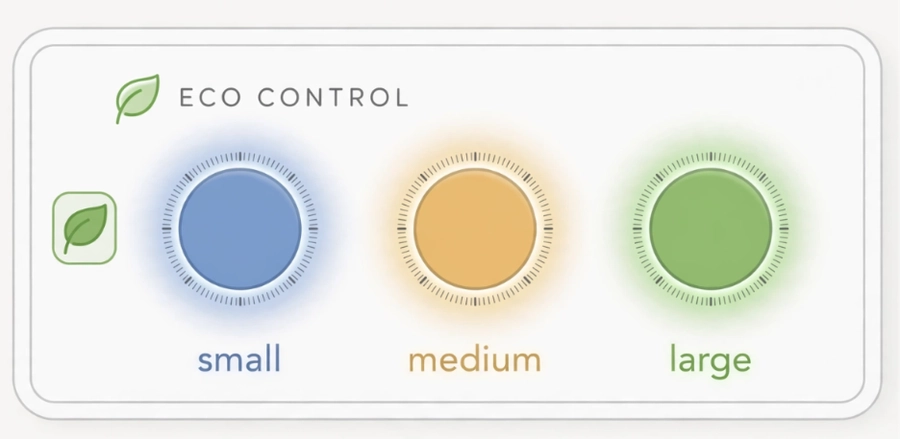
Habit number one is hard when your company is locked into a single AI app. Grengin gives teams models from OpenAI, Anthropic and Google in one approved workspace, so people can choose a lighter model for light work and save the heavy hitters for the jobs that need them. And because usage is visible in one place, sustainability teams get a starting point for understanding how much AI the company is really using.
The greenest AI strategy isn’t picking one perfect app. It’s using the right model, for the right job, with your eyes open.