AI has moved far beyond the “chatbot on the website” stage.
Today, enterprises are using conversational AI to support employees, automate workflows, assist customers, search internal knowledge, and interact with business systems. But as AI becomes part of everyday operations, choosing a platform is no longer simply about asking, “Which AI gives the best answers?”
The real question is: Which AI platform can your organization actually trust, govern, secure, and scale?
A conversational AI platform that works perfectly for an individual user may not necessarily be suitable for an enterprise handling confidential customer information, financial data, intellectual property, or regulated information.
That is why enterprise AI selection requires looking beyond model intelligence.
What Makes Enterprise Conversational AI Different?
Consumer AI platforms are generally optimized for convenience and individual productivity. Enterprise AI has a much longer checklist.
Organizations need to consider:
- Data privacy and security
- Access control
- Auditability
- Data residency
- Integration with existing systems
- Deployment flexibility
- Cost predictability
- Governance and compliance
- Scalability
- Vendor lock-in
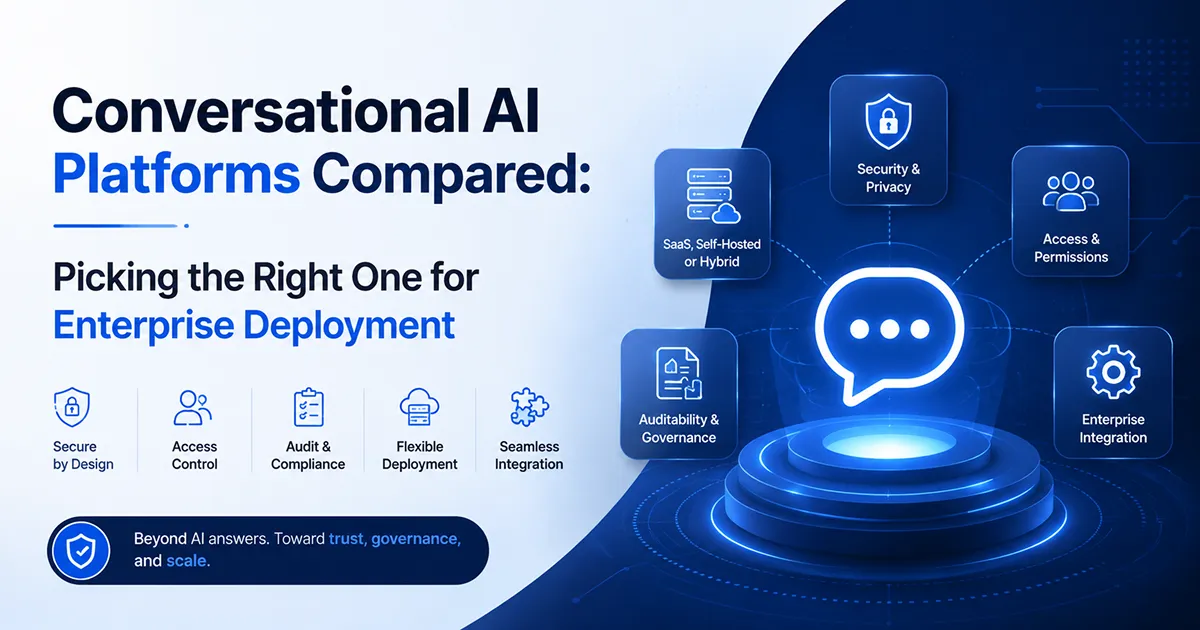
Modern enterprise conversational AI platforms increasingly compete on these factors alongside model quality. The ability to deploy, govern, integrate, and monitor AI can be just as important as the quality of the model itself.
SaaS, Self-Hosted, or Hybrid?
One of the first decisions an organization has to make is where its AI environment should run.
SaaS AI
With a Software-as-a-Service model, the provider manages the infrastructure, updates, scaling, and much of the operational complexity.
The biggest advantage is speed.
Teams can get started without building an AI infrastructure team from scratch. SaaS platforms can also make it easier to integrate AI into existing business applications.
However, organizations need to carefully evaluate where data goes, how it is processed, what controls are available, and what happens to data and logs after an interaction.
Self-Hosted AI
Self-hosted AI gives organizations significantly more control over the environment.
The organization can manage its infrastructure, network boundaries, access policies, encryption, model deployment, and data location.
This can be especially valuable for organizations with strict security or data-residency requirements.
But control comes with responsibility.
Infrastructure, monitoring, upgrades, model deployment, security patches, GPU capacity, and operational support become the organization’s responsibility.
Hybrid AI
For many enterprises, the answer does not have to be one or the other.
A hybrid approach can combine managed AI services for general workloads with private or self-hosted infrastructure for sensitive workloads.
This can provide a balance between speed, flexibility, security, and cost.
The Enterprise AI Checklist
Before selecting a conversational AI platform, organizations should ask several important questions.
1. Where Does My Data Go?
This should be one of the first questions—not an afterthought.
Organizations should understand the complete data path:
User → Application → AI platform → Model/provider → Storage/logging
A platform may advertise strong security while still leaving important questions unanswered about data processing, retention, logging, and third-party infrastructure.
For organizations with sensitive information, knowing the complete data path is critical.
2. Is My Data Used to Train Models?
Enterprises should clearly understand whether their business data is used for model training or improvement.
Organizations should look for clear contractual and technical controls around this issue.
3. Who Can Access the AI?
Enterprise AI cannot rely on a single shared login.
Organizations need centralized identity management, role-based permissions, department-level access controls, and ideally SSO.
For example, an HR employee may need access to HR-related workflows, while a finance employee should not automatically have access to the same information.
4. Can Every AI Interaction Be Audited?
AI interactions can become part of business processes.
That means organizations may need to know:
- Who used the system?
- When was it used?
- What information was submitted?
- Which model or system processed it?
- What response was generated?
- What actions followed?
Audit trails turn AI activity from a black box into something an organization can monitor and investigate.
5. Can the Platform Be Controlled Inside the Organization’s Security Boundary?
For sensitive deployments, organizations may need controls over:
- IAM
- Network access
- Encryption keys
- Infrastructure
- Cloud region
- Logging
- Data residency
This is where self-hosted and private deployment models can become particularly valuable.
Where Grengin Fits
Grengin’s approach is particularly relevant to organizations that want conversational AI without giving up control over their environment.
With self-deployment, Grengin is designed to allow organizations to deploy the system within their own environment and maintain greater control over their infrastructure and data flow.
The platform’s enterprise-oriented approach also focuses on areas such as access control, audit trails, security boundaries, and transparency.
That matters because enterprise AI is not only about generating a good response.
It is about being able to answer a much harder question:
“Can we prove what happened?”
Open-Source Transparency vs. Black-Box AI
Another factor worth considering is transparency.
Organizations increasingly want to understand how their AI systems behave, particularly when AI is used in sensitive workflows.
Open-source components can provide greater visibility into the technology stack and make customization easier. But open source does not automatically mean secure.
The organization still needs:
- Secure configuration
- Vulnerability management
- Access controls
- Monitoring
- Updates
- Governance
- Responsible deployment practices
In other words, transparency is useful—but governance turns transparency into operational control.
Cost: Don’t Look Only at the Subscription
AI pricing can be deceptive when organizations compare platforms.
A SaaS subscription may appear expensive at first but can include infrastructure, maintenance, upgrades, monitoring, and support.
Self-hosting may appear cheaper because the organization controls the software, but the total cost can include:
- Cloud or on-premise infrastructure
- GPUs
- Storage
- Networking
- DevOps
- Security
- Maintenance
- Monitoring
- Engineering salaries
Therefore, organizations should compare total cost of ownership, or TCO, rather than simply comparing subscription prices.
Choosing the Right Platform
There is no universal “best” conversational AI platform.
The right choice depends on the organization’s priorities.
A SaaS platform may be the better option when an organization prioritizes rapid deployment, managed infrastructure, and minimal operational overhead.
Self-hosted AI may make more sense when an organization requires greater control over infrastructure, data, security boundaries, or customization and has the expertise to manage the environment.
A hybrid approach can be useful when an organization has different security requirements for different workloads.
The important thing is to evaluate the platform against the organization’s actual requirements rather than choosing based solely on model popularity or marketing claims.
Final Takeaway
Enterprise AI should not be selected like a consumer app.
The smartest organization is not necessarily the one using the most powerful model. It is the one that can balance intelligence, security, governance, cost, control, and scalability.
Before choosing a platform, ask:
“Can we control it? Can we secure it? Can we audit it? Can we scale it? And can we explain what happens to our data?”
If the answer to those questions is clear, the organization is much closer to choosing an AI platform that is ready not just for a pilot—but for production.
Enterprise conversational AI is ultimately not about choosing between “the smartest model” and “the cheapest platform.”
It is about choosing an architecture that your business can trust.