
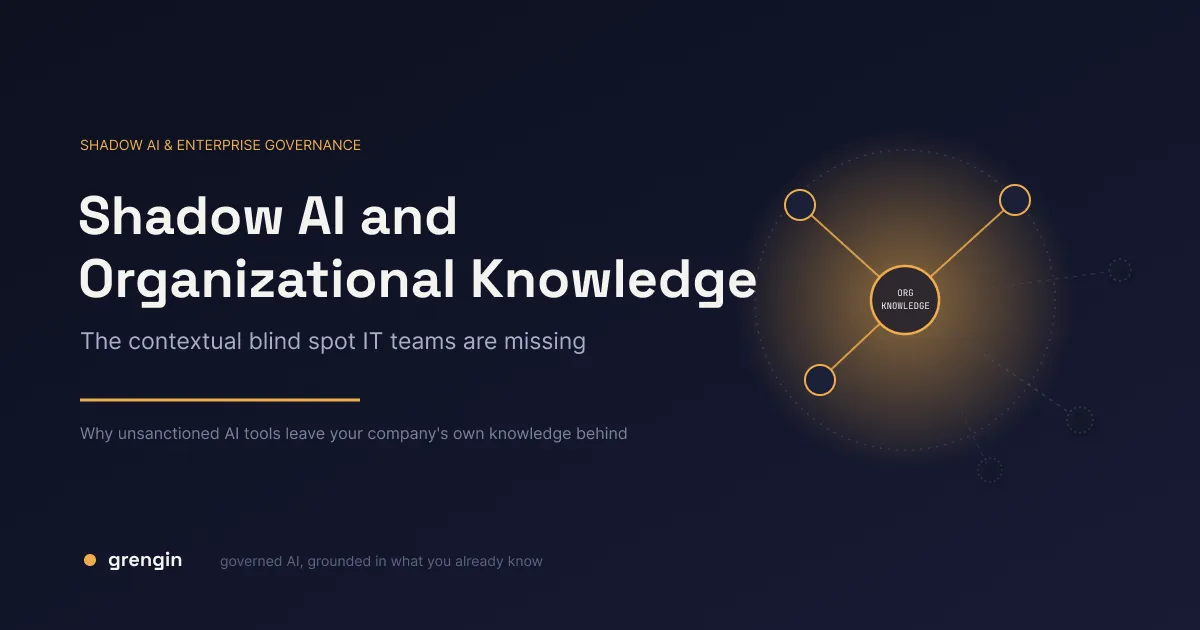
Every IT leader knows shadow AI exists. Fewer realize it’s not just a security problem — it’s a context problem. When employees route work through unsanctioned tools, they’re not just risking data leaks. They’re generating decisions, drafts, and summaries that have zero connection to what the organization actually knows.
That gap — between what employees are asking AI and what the business actually knows — is the blind spot most governance conversations miss. This article breaks down why it happens, what it costs, and how platforms like Grengin are built specifically to close it.
What Is Shadow AI, Really?
Shadow AI is any AI tool — chatbot, browser extension, personal account, or embedded SaaS feature — used for work without IT’s knowledge or approval.
Recent industry research paints a consistent picture:
| Stat | Data Point |
|---|---|
| Organizations reporting moderate-to-pervasive shadow AI use | 80% |
| Organizations with full visibility into employee AI use | ~25–30% |
| Employees who use personal AI accounts to bypass controls | 47% |
| Organizations with a formal AI governance policy | 36% |
| Extra cost per breach linked to shadow AI incidents | $670,000+ |
| Enterprise AI failures Gartner attributes partly to shadow AI (by 2027) | 40% |
(Sources: Optro AI Oversight Gap 2026, Netskope 2026, IBM Cost of a Data Breach 2025, Gartner)
The takeaway: shadow AI isn’t a fringe behavior. For most companies, it’s the dominant way employees actually use AI at work — just without any oversight layer watching what goes in or comes out.
The Real Blind Spot: It’s Not Just Security. It’s Context.
Most governance conversations stop at “employees might leak data.” That’s true — but it misses the deeper issue.
When someone pastes a contract into ChatGPT, or asks Copilot to draft a policy summary, that tool has no idea:
-
What your company’s actual policies say
-
Which version of a document is current
-
What past decisions already ruled out
-
Who owns a process or has final sign-off
-
What internal terminology or context means
-
The AI answers confidently anyway — using generic, public-internet knowledge dressed up as an informed answer.
That’s the contextual blind spot: employees get an answer, but the organization gets zero institutional memory out of the exchange. Every shadow AI conversation is a missed opportunity to build organizational knowledge — and a risk that the answer was subtly wrong.
Why this matters more than data leakage alone
| Risk Type | What Happens |
|---|---|
| Data leakage | Sensitive info leaves the organization’s control |
| Contextual drift | Employees act on advice that ignores internal policy, past decisions, or current data |
| Knowledge fragmentation | Every employee’s AI conversations live in a different, ungoverned silo |
| No institutional memory | Nothing learned in an AI chat feeds back into the company’s collective knowledge |
| Compounding errors | Wrong context in one AI answer gets copied into decks, emails, and decisions downstream |
Why IT Teams Keep Missing This
It’s not negligence — it’s tooling. Most shadow AI conversations happen through:
- Public tools (ChatGPT, Gemini, Claude web apps) — no enterprise context possible
- Embedded SaaS AI (Copilot in Microsoft 365) — contextual only within that one ecosystem
- Self-hosted open-source chat UIs (OpenWebUI, LibreChat) — great for control, but organizational knowledge and governance have to be bolted on separately
None of these were built to answer one specific question: “What does THIS company already know about this?”
This is exactly the gap Grengin was designed to close — by combining self-hosted governance with semantic search over an organization’s own knowledge and conversation history, so answers are grounded in company reality, not just public training data.
Comparing the Landscape: Where Each Platform Stands
| Platform | Governance & RBAC | Self-Hosted / Data Control | Org Knowledge Context (RAG) | Audit Trail | Best For |
|---|---|---|---|---|---|
| ChatGPT Enterprise | Basic admin controls | No (vendor-hosted) | Limited, manual setup | Partial | Quick adoption, low customization |
| Microsoft 365 Copilot | Strong within M365 | No (Microsoft cloud) | Only M365 data | Yes (M365 scope) | Microsoft-centric orgs |
| OpenWebUI | Minimal, DIY | Yes | Requires manual config | No native audit log | Technical teams, hobby/dev use |
| LibreChat | Minimal, DIY | Yes | Requires manual config | No native audit log | Developers wanting flexibility |
| Grengin | Granular RBAC, department budgets | Yes, fully self-hosted | Built-in semantic search over org knowledge & conversation history | Tamper-evident audit logs | Enterprises needing governed AI with context |
The pattern is clear: public tools (ChatGPT, Copilot) give you convenience but no data control. Open-source chat UIs (OpenWebUI, LibreChat) give you control but leave governance and organizational context as a DIY project. Grengin is positioned in the gap between the two — self-hosted control plus the governance and contextual grounding that open-source alternatives don’t ship with out of the box.
How Grengin Closes the Contextual Blind Spot
Here’s what actually solves the problem, not just detects it:
- Semantic search over organizational knowledge — Grengin indexes conversation history and company knowledge so answers reflect what the business already knows, not just generic model training data
- Role-based access control (RBAC) — custom roles like
analytics:vieworai-platform:manage, scoped at org or department level - Department budgets — spend visibility and control per team, so AI usage doesn’t become an invisible cost center
- MCP tool integrations — connect internal tools securely with per-tool access policies instead of employees improvising with public plugins
- Tamper-evident audit logs — every administrative action is logged and exportable for compliance
- Multi-provider LLM routing — OpenAI, Anthropic, Mistral, Gemini — swap providers without changing the frontend or losing governance
- Self-hosted deployment — data never leaves infrastructure you control, unlike ChatGPT or Copilot’s vendor-hosted models
In short: Grengin doesn’t just block shadow AI. It replaces the reason people go around IT in the first place — a fast, contextual, capable AI experience — with a governed alternative that’s actually as good or better.
A Practical Checklist for IT Teams
Before you can fix the contextual blind spot, you need visibility. Start here:
- Audit current usage — anonymous surveys plus network/browser traffic review
- Identify where context is missing — which teams are getting generic AI answers on company-specific questions?
- Provide an approved alternative fast — banning tools without a replacement just pushes usage further underground
- Choose a platform with built-in organizational context — this is where tools like Grengin differ from a bare open-source chat UI
- Set department-level policies and budgets — visibility into both usage and cost
- Review audit logs regularly — don’t wait for annual audits; shadow AI moves faster than that
FAQ
1. What’s the difference between shadow AI and shadow IT?
- Shadow IT covers any unapproved technology — apps, cloud services, devices. Shadow AI is the AI-specific subset: unsanctioned chatbots, AI browser extensions, and personal AI accounts used for work tasks without IT’s knowledge.
2. Can’t we just block AI tools at the network level?
- Blocking alone tends to push usage further underground rather than eliminating it, since employees still need to hit deadlines. Most guidance — including from GRC and security researchers — recommends providing a governed, capable alternative alongside any restrictions.
3. How is “organizational knowledge context” different from just using an enterprise AI plan like ChatGPT Enterprise or Copilot?
- Enterprise plans add admin controls and data protections, but they don’t automatically index your company’s own knowledge and past conversations. Without that layer, employees still get answers grounded in generic training data rather than your organization’s actual policies, decisions, and documents — which is the specific gap platforms like Grengin are built to close.
4. Is a self-hosted platform like Grengin harder to deploy than OpenWebUI or LibreChat?
- Not necessarily. Grengin ships with pre-built cloud marketplace images and a one-line installer with a guided setup wizard, aiming to match the deployment simplicity of open-source alternatives while adding governance and context features that typically require manual configuration elsewhere.
5. What’s the first step if we suspect shadow AI but have no visibility yet?
- Start with an anonymous employee survey combined with a review of network and browser AI traffic. This gives you a realistic baseline before you pick a governance platform or write policy — acting on assumptions alone tends to produce rules employees route around.
Shadow AI isn’t going away — and banning it outright rarely works. The real fix is closing the contextual blind spot: giving employees a governed AI experience that actually knows what your organization knows. That’s the problem Grengin was built to solve.