
AI has never been cheaper per word, and some of its heaviest users have never run out of budget faster. Both things are true this autumn.
Anthropic cut Claude Opus 5.5’s prices 20% below Opus 5 and says typical workloads cost about 40% less. Google is selling Gemini 4 Argon at half price until December 1. Yet during one week of testing both testers hit their weekly usage limits, and one run used up a tester’s whole allowance and cost him his last day of testing.
The explanation is simple once you see it. The new models are cheaper per token and far faster per task, but they also attempt much bigger jobs. Here is what real users are saving, what they are actually paying, and how to keep the savings.
The time savings are real
On the tasks people have reported so far, the new models cut working time by a fifth at minimum and by almost all of it at best.
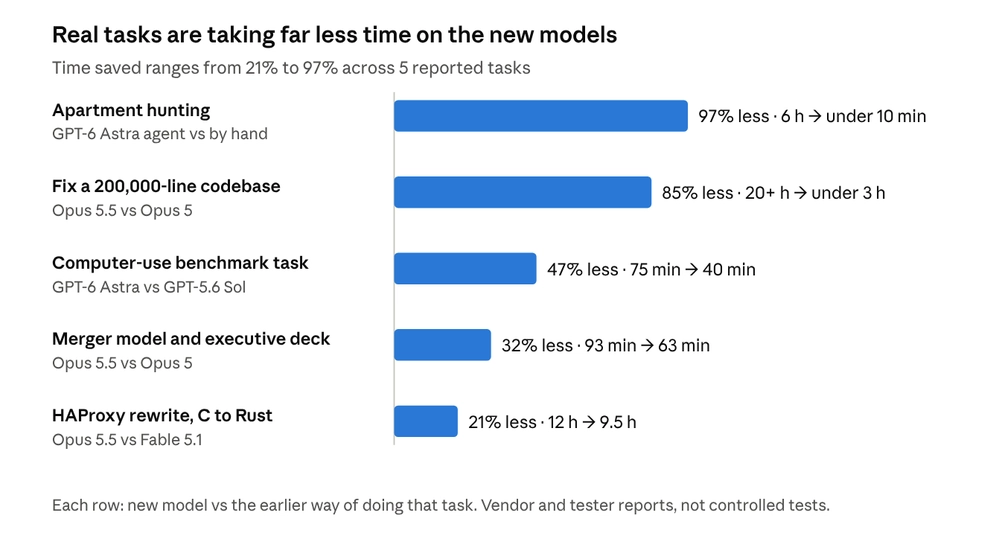 Sources: AFP (OpenAI demo), Puter (Anthropic-cited tester), CodingFleet, CometAPI · reported Sept–Oct 2026
The biggest jumps come when an AI agent replaces hours of manual clicking, as in OpenAI’s apartment-hunting demo. The smallest come when a new model is measured against an already strong one, like Opus 5.5 against Fable 5.1 on the HAProxy rewrite, which was also 51% cheaper. Writing counts too: Dan Shipper says Gemini 4 Argon cut two to three days off an 8,000-word project.
Price per token is a trap. Price per task is the bill.
The sticker price tells you little until you know how many tokens a model burns to finish a job. OpenAI president Greg Brockman made the same point at Astra’s launch, saying price per task is what matters.

| Model | List price (per 1M tokens, in / out) | What a real task cost |
|---|---|---|
| GPT-6 Astra | $10 / $50 | About $3.26 per task, using ~27,000 output tokens |
| Claude Fable 5.1 | $10 / $50 | $6.00 for a sample agentic coding session |
| Claude Opus 5.5 | $4 / $20 | $2.88 for the same session, 52% less than Fable 5.1 |
| Gemini 4 Argon | $2 / $10 until Dec 1 | About $1.99 per task now, ~$3.98 after the discount, using ~62,000 output tokens |
Three things stand out from real bills.
Fewer tokens beat lower prices. Anthropic’s early tester who fixed a 200,000-line codebase used 2.5 times fewer tokens than with Opus 5. Combined with the 20% price cut, that works out to roughly 68% lower cost for that task (Puter).
A cheap model can still be the pricier one. Argon’s per-token price is the lowest here, but it writes about 2.3 times as many output tokens as Astra on the same task. Once the discount ends, it is more expensive per task (eesel).
Fine print can double a bill. On Astra, any prompt longer than 272,000 input tokens reprices the entire request. One estimate puts Astra at about $167 per task across demanding coding benchmarks (CodingFleet).
The effort dial: where most of the money leaks
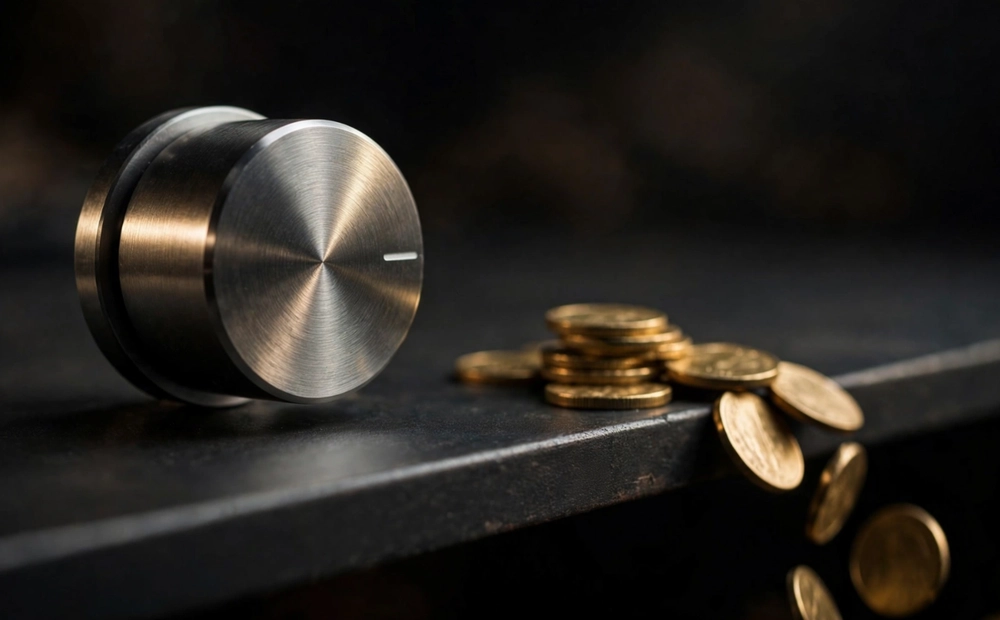
All of these models now have an effort setting, from low to max, that decides how long the model thinks before answering. Turning it up feels like buying quality. The data shows that past a certain point, you are mostly buying tokens.
At max effort, Artificial Analysis measured Opus 5.5 writing about 119,000 output tokens per task, against about 27,000 for Astra. That is why Opus 5.5 at max costs $5.98 per task and Astra $3.26, even though Opus is 2.5 times cheaper per token. Turn Opus down to high and the same evaluator reports $1.82 per task, with a slightly higher score than Astra at max (Kingy AI).
On the Terminal-Bench 4.0 coding test, the waste is easy to see:
| Opus 5.5 effort | Score | Cost per attempt |
|---|---|---|
| Low | 38.5% | $1.29 |
| Medium | 57.6% | $2.94 |
| High | 64.2% | $3.88 |
| Extra high | 66.4% | $7.35 |
| Max | 64.8% | $11.24 |
Going from high to extra high adds 2.2 points for 89% more money. Max then costs another 53% on top and scores 1.6 points lower. Paying the most for a worse result is waste in its purest form.
One of Anthropic’s own launch charts tells the same story: Opus 5.5 at medium scored 54.6% at $0.80 per task, while max scored 54.4% at $6.19. That is nearly eight times the cost for the same result.
What that waste looks like in a real budget. A team running 1,000 of those tasks a month would pay about $800 at medium and about $6,190 at max. That is roughly $5,390 a month, or about $65,000 a year, spent for no gain.
The same dial matters when you compare brands. On the same coding test, Opus 5.5 at medium (57.6%) nearly matches Astra at high (57.9%) for about 41% of the cost. On Zapier’s AutomationBench, which tests everyday business workflows, Opus 5.5 scored 42.47% at $1.44 per task against Astra’s 41.4% at $1.73.
Where the tokens actually go
Every word a model writes, including its hidden thinking, lands on your bill. Here is what the usage data shows.
Thinking volume. Across the full Artificial Analysis test suite at max effort, Opus 5.5 wrote about 260 million output tokens, against about 60 million for Astra. Same tests, more than four times the writing.
What each extra token costs. If a higher setting adds 20,000 output tokens to a task, that is $1 more on Astra and $0.40 more on Opus 5.5. Small per task, but it adds up to $1,000 or $400 over 1,000 tasks.
Wordiness is waste too. Every’s writers found Opus 5.5 took 37 to 39 sentences to say what a human said in 21. Teams that tuned for brevity saw the opposite: Box reports Opus 5.5’s answers were 40% less wordy than before, and Factory saw 20 to 25% fewer output tokens than with Opus 5 at the same effort.
Fewer steps, fewer tokens. GitHub found Opus 5.5 solved more terminal tasks in VS Code than Opus 5 in less than half the steps. Every step an agent skips is tokens you don’t pay for.
Waiting has a price. Opus 5.5 writes 79 to 92 tokens per second, against 47 to 55 for Astra. At high effort, Opus 5.5 starts answering in about 13 seconds, while Astra takes about 79. For anything where a person sits waiting, those minutes are salary.
The fine print. Astra’s Fast mode doubles its rates, and Opus 5.5’s Fast mode costs $8 and $40 per million tokens. Astra charges five times more than Opus 5.5 for cached input. And once an Astra prompt passes 272,000 input tokens, the whole request is billed at $20 and $75 per million.
The hidden costs nobody puts on the pricing page
The biggest costs users report are not token prices. They are runaway sessions, work that looks finished but isn’t, and the human time spent checking it.
Models that don’t know when to stop. Every’s designer Tyler Nishida gave Opus 5.5 one prompt for a golf game. It spun up its own team of agents and ran for 1 hour and 52 minutes, stopping only when his access ended. He loved the result, but he also said he can’t afford another $200 subscription, so something else has to go.
Expensive work that quietly fails. Mike Taylor’s voice-form app took 30 minutes and about 5.9 million tokens, roughly $7.63 at Opus 5 prices. Its own checks came back green, yet the main screens threw errors when he used it. Money spent, nothing usable.
The last mile still needs a human. Theo of t3.gg watched Astra open a pull request in 10 minutes, agree that review comments needed fixing, then fix them without pushing the changes. Fast work is only cheap if someone notices what was skipped.
More catches, more tokens. CodeRabbit found Opus 5.5 caught more hard bugs but used about 50% more tokens, and missed 9 bugs its existing setup caught.
Safety checks that pause real work. On the API, Astra’s cybersecurity check stops a flagged task outright, and users should expect occasional pauses or blocks, sometimes on work unrelated to security.
How to actually keep the savings

The users who saved the most did five things, and none of them needs a technical background.
- Start at the lowest effort setting. Deloitte found Opus 5.5 at its lowest effort caught more bugs than Opus 5 at high effort, and CodeRabbit found the standard setting gave a better balance than the maximum one. Only turn effort up when the cheap run falls short, and never jump straight to max.
- Give every long task a budget and a finish line. Every’s testers recommend defining what “done” means, setting a budget and adding a stopping point before any long-running task.
- Check the work yourself before you pay for more. Run the app, read the changes and open the file. A passing automated check is not proof, as Mike Taylor’s broken app showed.
- Reuse your context and watch the price cliff. Opus 5.5 cut cache-read prices by 60%, and in one sample session cache reads made up 41% of the old Opus 5 bill. On Astra, keep prompts under 272,000 input tokens, or the whole request is billed at the higher rate.
- Time your experiments. Argon’s half-price period runs until December 1, which makes now the cheapest moment to test it on your own work.
The bottom line: these models really are saving people hours and money, but only for people who manage them like a capable new hire. Give clear limits, check the output and measure the cost per finished job, not per token.
Don’t pay for AI you don’t need
AI pricing changes every few weeks, and most of the savings hide in settings nobody explains. We track what real people actually spend and get back, in plain English, with real numbers and no hype.
Follow us so the next breakdown reaches you before your next AI bill does.
Now over to you: what is the most you have spent on a single AI task, and was it worth it? Share it in the comments, and we’ll feature the most surprising answers in our next post.
If this could save your team money, send it to the person who approves your AI budget.