
LibreChat is one of the most impressive open-source AI projects out there. Whether it’s the right choice for your team is a different question entirely.
When OpenAI released ChatGPT, the obvious question from every privacy-conscious engineering team was: can we run something like this ourselves? No vendor dependency, no data leaving our perimeter, no per-seat pricing that scales uncomfortably as headcount grows.
LibreChat is the most serious answer that question has produced. It’s a self-hosted, open-source AI chat platform that looks a lot like ChatGPT, supports most of the major model providers, and has an active GitHub community that keeps it moving. If you’ve spent any time looking at open-source AI tooling, you’ve probably run into it.
This review is for the people who are past the “looks interesting” stage and into the “should we actually deploy this for 40 people” stage. The answer depends heavily on what your team looks like and what you’re expecting the platform to handle.
What LibreChat actually is
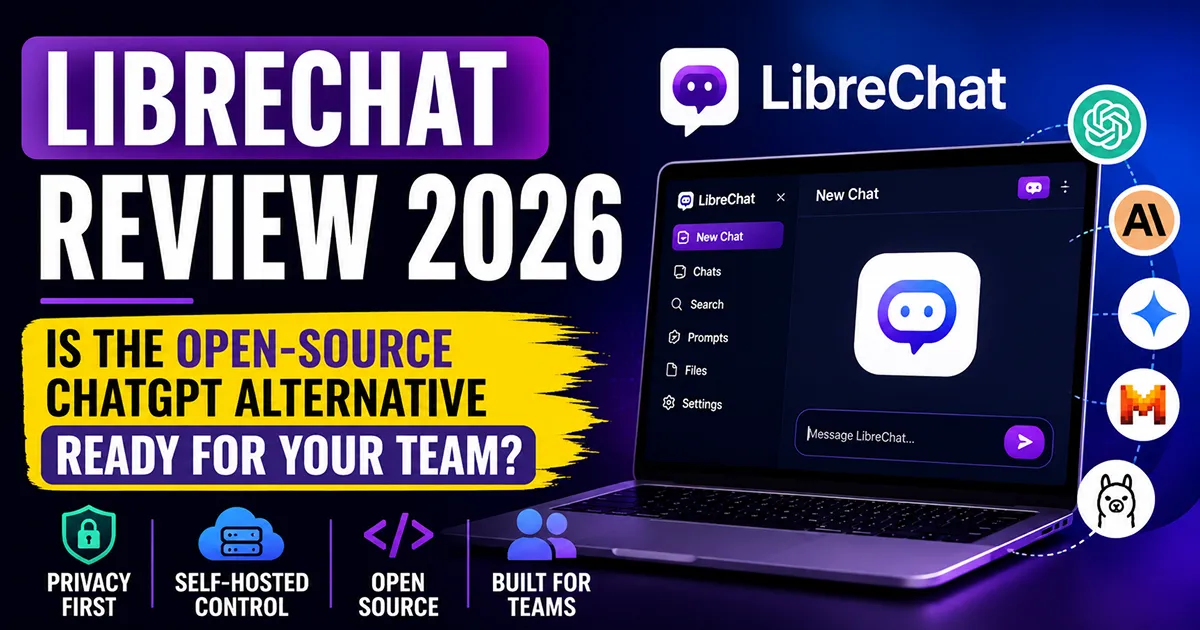
LibreChat is a web-based chat interface you run on your own server. You bring the AI models — it connects to OpenAI, Anthropic, Google Gemini, Mistral, Azure OpenAI, and a range of local models via Ollama — and LibreChat handles the interface, conversation history, and user management.
The project lives on GitHub, releases regularly, and as of 2026 has accumulated a substantial community of contributors and a Discord that’s genuinely active. It’s not a side project someone maintains on weekends. It’s a real piece of software with real momentum.
What it isn’t is a SaaS. There’s no LibreChat server you log into. You run it yourself, you maintain it yourself, and when something breaks, you fix it yourself. That’s not a criticism — it’s the point. It’s also the thing most teams underestimate.
What LibreChat genuinely gets right
Model flexibility is real. The ability to switch between GPT-4o, Claude, Gemini, and local models inside the same interface, under the same chat history, is something most commercial platforms still don’t offer cleanly. For teams that want to compare outputs across providers or use different models for different tasks, this is a genuine advantage.
The interface is good. It’s clearly modeled on ChatGPT and that’s fine — ChatGPT has a good interface. Conversation management, search, file uploads, image generation support, and a prompt library are all present and functional. Non-technical users who are already familiar with ChatGPT can orient themselves in LibreChat without much friction.
Privacy by architecture. Because you’re running it on your own infrastructure, and because your API calls go directly to the model providers without routing through a third party, the data story is as clean as your own infrastructure choices. You’re not trusting LibreChat’s servers because there aren’t any. That’s a meaningful property for teams with genuine data sensitivity requirements.
It’s free. Not “free tier” — actually free. The software costs nothing. You pay for compute and for the model API calls you make, the same way you’d pay for them if you called the APIs directly. For teams that already have cloud infrastructure, the marginal cost of running LibreChat is low.
The community is real. The GitHub issue tracker moves fast, the Discord has people who know the codebase, and the documentation — while not enterprise-grade — covers enough to get a technical team running. This matters more than people expect when you hit a configuration problem at 11pm.
The setup reality nobody tells you upfront
Most LibreChat walkthroughs make deployment sound like running docker compose up and being done. That’s true in the same way that “assembling furniture” sounds simple before you open the box.
Getting LibreChat running locally takes maybe 20 minutes for someone comfortable with Docker. Getting it running in a production environment that you’d actually trust with company data is a different project.
You need to think about where it’s hosted and whether that environment is locked down properly. You need to set up a domain, configure SSL, and handle secrets management for your API keys. If you want SSO — so employees log in with their Google or Microsoft credentials instead of a separate password — that requires configuring an external auth provider, which is documented but not trivial. If you want HTTPS with automatic certificate renewal, that’s another configuration layer.
None of this is technically hard if you have a DevOps engineer or a strong generalist on the team. It’s a half-day project, maybe a full day if you want it done properly. The problem is that it’s also not the last day you’ll spend on it. LibreChat releases updates regularly. Security patches need to be applied. Infrastructure needs to be monitored. When a new model comes out that your team wants to use, someone needs to wire up the API key and test the integration.
For a team with dedicated infrastructure support, this is manageable overhead. For a team where “can you set up the LibreChat server” falls to the one person who knows what Docker is, it eventually becomes a burden — or it stops being maintained properly, which is worse.
Where it runs into enterprise requirements
LibreChat is built for users who want control over their AI environment. It’s designed well for that. But enterprise procurement and IT teams often have a checklist, and LibreChat checks some boxes completely, some partially, and some not at all.
SSO and SCIM. SSO is supported through configuration — LDAP, SAML, and OAuth providers work. SCIM, which is how enterprise HR systems automatically provision and deprovision user accounts, is not natively supported as of this writing. That matters if you’re in an organization where IT expects user management to be automatic, not manual.
Audit logs. LibreChat logs conversations and has some admin visibility, but the audit trail is not designed for compliance use cases. If your security team wants a structured, exportable log of who asked what, when, and what the model returned — the kind of log that goes into a SIEM or satisfies a compliance requirement — you’re building that yourself on top of the existing infrastructure.
Role-based access control. User roles exist, but they’re relatively blunt — admin or user, essentially. The ability to say “the legal team can query documents in this folder but not that one, and cannot use the image generation feature” is not something you configure through the LibreChat UI. It’s something you architect around it.
Support. There is no support contract. There is no SLA. When something breaks, you’re in the GitHub issues or Discord, and the response time depends on whether someone in the community has seen your problem before. For teams where downtime has business consequences, this is the risk that’s hardest to quantify and easiest to underestimate.
The honest cost picture
LibreChat is free. The total cost of running LibreChat for a team is not.
Add up the time to deploy and configure it properly. Add the monthly cost of the server it runs on (a small VM, probably $20–60/month depending on your cloud provider). Add the engineering time for each update cycle. Add the time spent when something breaks or when a new team member needs help getting access.
For a team of five engineers who enjoy this kind of thing, the math works clearly in LibreChat’s favor. For a team of 50 people in a mix of technical and non-technical roles, the math gets murkier quickly. The API calls will cost roughly the same either way. The difference is how much internal time gets spent keeping the platform running versus using it.
None of this means LibreChat is expensive. It means it isn’t free in the way people sometimes assume when they see the $0 price tag.
Who should actually use LibreChat
Be concrete about this: LibreChat is excellent for technical teams and developers who want full control, don’t want to pay per-seat fees, and have the infrastructure competency to manage a self-hosted deployment. Individual contributors, small engineering teams, and privacy-focused organizations with DevOps resources in-house will find it genuinely compelling.
It’s less well-suited for cross-functional teams where non-technical departments are primary users, for organizations with compliance requirements that need structured audit trails and SCIM provisioning, or for teams where no one has time to maintain the infrastructure alongside their primary job.
The question to ask isn’t “is LibreChat good?” — it is. The question is whether the kind of work it requires aligns with what your team is set up to do.
Verdict
LibreChat is one of the best things to happen to enterprise AI tooling in the last two years. It proved that a capable, multi-model AI platform could be built in the open, maintained by a community, and deployed without handing your data to a third party. The project continues to move fast and the quality has improved significantly over its lifetime.
For the right team, it’s the correct answer. For a team that wants LibreChat’s core properties — runs in your own environment, doesn’t touch your billing, same software no matter how you deploy it — but needs that wrapped in something that handles the maintenance, SSO, audit logs, and enterprise access controls, the tradeoff calculation looks different.
That’s the decision worth spending time on, rather than whether LibreChat itself is good. It is. The question is whether running it is the right use of your team’s time.
Grengin is built on the same premise as LibreChat — your infrastructure, your data, no vendor in the middle — with the enterprise layer already included.
SSO, role-based access control, and full audit logs are part of the deployment, not separate configuration projects. There are three ways to run it: self-host from source (free, docker compose up, no feature gates), one-click deploy on AWS Marketplace, or Azure Marketplace launching soon. We never see your card, your data, or your conversations.
If you’re evaluating LibreChat and want to see what the same infrastructure-first model looks like with the enterprise requirements already handled, view it on GitHub or launch it on AWS/Azure.