10 Questions to Ask Before Buying Any Enterprise AI Tool
“It has AI.”
Okay. And…?
That’s not exactly enough information to spend thousands of dollars on a tool.
Yet, this is how many companies approach AI buying decisions: impressive demo, fancy features, a few buzzwords—and suddenly everyone is ready to sign the contract.
But before your company buys another AI tool, IT teams should probably ask a few uncomfortable questions.
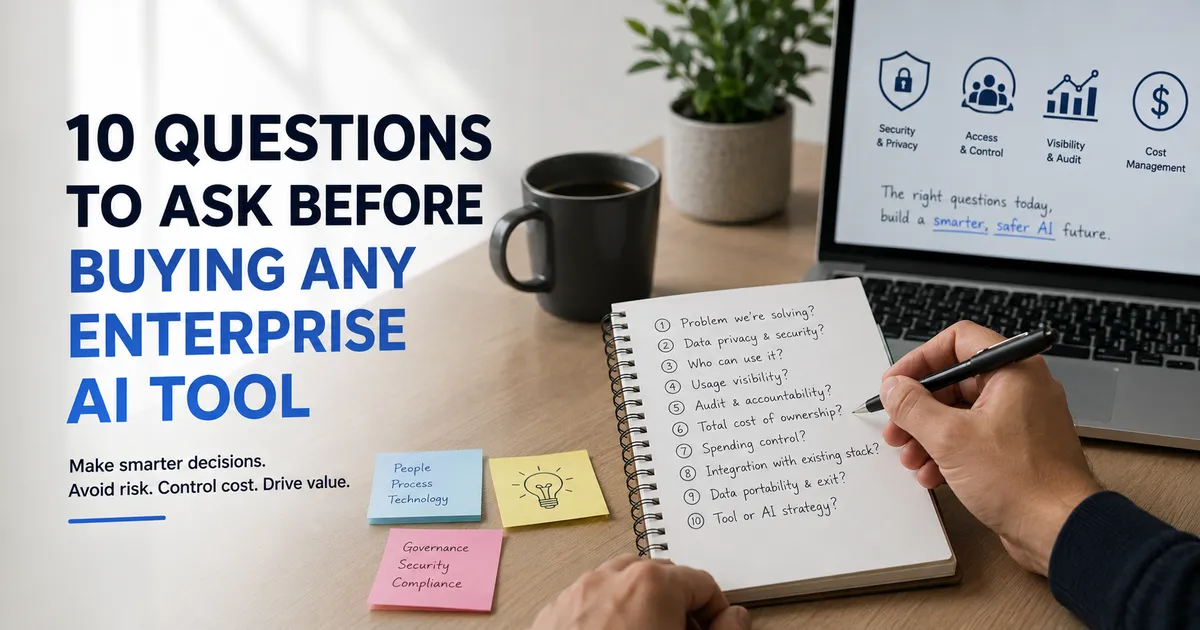
1. What problem are we actually solving?
If the answer is “We need AI because everyone is using AI,” pause.
A tool should solve a business problem, not create another subscription.
Start with the workflow, the pain point, and the expected outcome. Then look for the technology.
2. Where does our data go?
This should never be an afterthought.
Before employees start uploading contracts, customer information, internal documents, or source code, understand how the vendor handles your data.
Ask about data storage, retention, encryption, third-party access, and whether customer data is used for model training.
Because “we’ll figure out the privacy part later” is not exactly a great security strategy.
3. Who can use it?
Should everyone have access?
Probably not.
A finance team, developer, HR department, and marketing team may need very different levels of AI access.
Look for proper user management, permissions, SSO, and department-level controls.
4. Can we see what people are actually doing with it?
Buying an AI tool without visibility is a little like handing out company credit cards and saying, “Just use them responsibly.”
You need usage visibility.
Who is using it? How often? For what purpose? Which features are being used?
Without that information, it becomes difficult to manage both risk and spending.
5. Can we audit AI activity?
What happens when an AI-generated answer causes a problem six months from now?
Can you find out:
Who used the tool? Which model was involved? What happened? When did it happen?
If the answer is no, you may have an AI tool—but not much accountability.
6. What will it actually cost us?
The price on the website isn’t always the final price.
Think beyond the subscription.
Consider usage, API costs, infrastructure, integrations, implementation, maintenance, and employee time.
A tool that looks cheap initially can become surprisingly expensive at scale.
7. Can we control spending?
If usage increases, does your bill increase with it?
Look for usage monitoring, budgets, alerts, spending limits, and department-level tracking.
Because discovering your AI bill at the end of the month shouldn’t be your company’s cost-control strategy.
8. Can it integrate with what we already use?
Your company probably doesn’t need another isolated dashboard.
Check whether the AI platform works with your existing identity systems, cloud infrastructure, security tools, applications, and workflows.
Good technology should fit into your environment—not force your entire environment to fit around it.
9. What happens if we want to leave?
This question gets ignored surprisingly often.
Before committing, understand data portability, export options, contracts, cancellation terms, and how difficult it would be to move to another provider.
Vendor lock-in is much easier to avoid before signing the contract than after.
10. Are we buying a tool—or building an AI strategy?
This might be the biggest question of all.
Buying an AI tool is easy.
Building a controlled, secure, cost-effective AI environment is harder.
Companies need to think about governance, security, access, data, compliance, cost, and long-term scalability—not just which chatbot has the coolest demo.
The Bottom Line
AI is moving quickly.
That doesn’t mean companies need to buy everything quickly.
Before approving the next enterprise AI purchase, ask the uncomfortable questions.
Because the best AI investment isn’t necessarily the tool with the longest feature list.
It’s the one your company can actually control, secure, afford, and scale.
And yes, “it has AI” can finally stop being the entire business case.