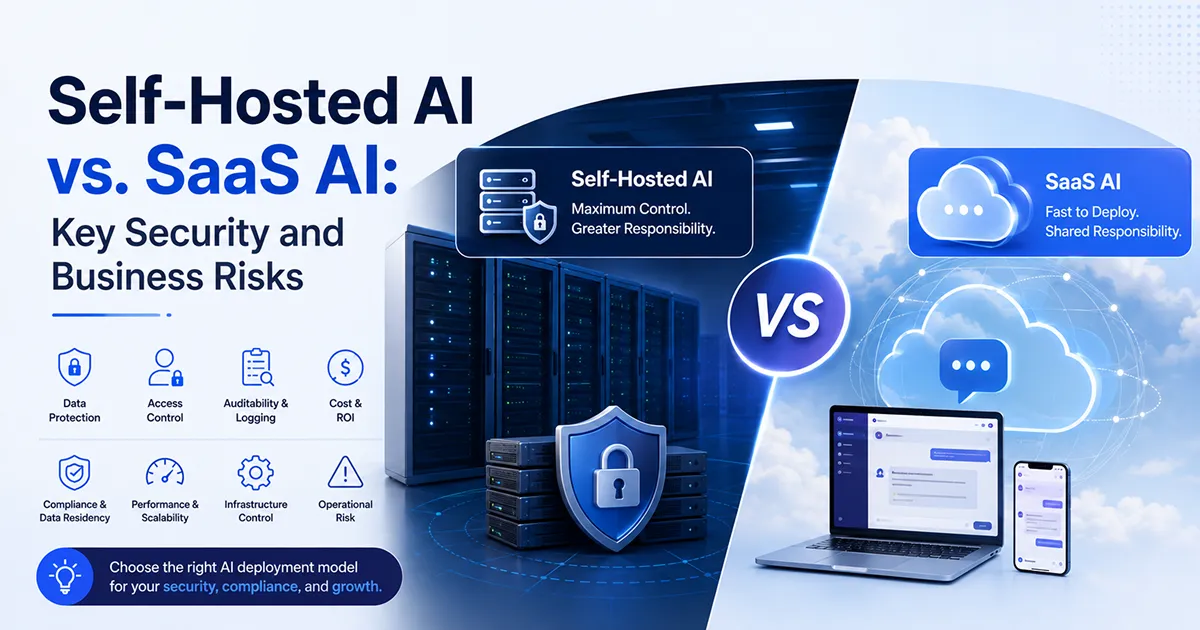
Should your company run AI on its own infrastructure—or simply subscribe to an AI platform?
It sounds like a technology question.
In reality, it is a business, security, governance, and cost decision.
As organizations move AI from experimentation into real business workflows, the choice between self-hosted and SaaS AI becomes increasingly important. The deployment model affects where data goes, who controls the infrastructure, how quickly the system can be deployed, how much engineering effort is required, and what the organization is responsible for when something goes wrong.
Neither model is automatically safer.
The better question is:
“Which model gives your organization the right level of control for the risk it is willing to accept?”
What Is SaaS AI?
SaaS AI is an AI service managed by an external provider.
The provider generally handles infrastructure, software updates, scaling, availability, and much of the underlying maintenance.
For a business, this can be incredibly convenient.
Instead of hiring a team to manage GPUs, model deployments, networking, monitoring, and upgrades, the organization can start using the service relatively quickly.
That is the biggest advantage of SaaS:
Speed without infrastructure complexity.
But convenience does not eliminate risk.
It changes where the responsibility sits.
What Is Self-Hosted AI?
Self-hosted AI runs within infrastructure controlled by the organization—or infrastructure that the organization manages directly.
This could mean:
- On-premises servers
- Private cloud
- A controlled VPC
- Dedicated infrastructure
- An isolated environment
The organization has greater control over its data path, network boundaries, identity systems, infrastructure, and deployment environment.
For highly sensitive workloads, this can be a major advantage.
But there is an important catch:
You also inherit the responsibility.
If your organization manages the infrastructure, it also needs to manage security, updates, monitoring, availability, and incident response.
Security Risk #1: Data Exposure
The first concern with SaaS AI is data exposure.
Whenever business information is sent to an external service, organizations need to understand:
- Where the information is processed
- Where it is stored
- How long it is retained
- Who can access it
- Whether it is used for training
- Which third parties are involved
- Which geographical regions are involved
Data residency can be particularly important for regulated organizations.
A SaaS platform may offer regional hosting or data-residency controls, but organizations should not assume that “stored in our region” automatically means “fully controlled by us.”
Self-hosted environments can provide stronger direct control over data location and infrastructure boundaries.
Security Risk #2: The “Self-Hosted = Automatically Secure” Myth
Self-hosting sounds secure because the organization controls the environment.
But control is not the same thing as security.
A poorly configured private AI system can still have:
- Weak authentication
- Excessive permissions
- Unpatched software
- Exposed APIs
- Poor network segmentation
- Inadequate logging
- Vulnerable dependencies
The organization has to build and maintain the security around the AI system.
That means self-hosting can reduce certain third-party risks while simultaneously introducing additional operational responsibilities.
Security Risk #3: Access Control
Imagine an organization has 500 employees using an AI system.
Should everyone have the same access?
Obviously not.
A proper enterprise deployment should consider:
- Who can access the system?
- What can they access?
- What information can they submit?
- What actions can they perform?
Centralized identity management, SSO, role-based access control, and department-level policies become increasingly important as AI usage expands.
Without them, an organization can end up with “shadow AI”—employees using unapproved AI tools with company information.
That creates a governance problem even if the official enterprise AI platform is secure.
Security Risk #4: Auditability
If an employee accidentally exposes confidential information to an AI system, the organization needs to investigate what happened.
Without proper logging, that investigation becomes difficult.
Enterprise AI governance should ideally provide visibility into:
- User identity
- Time and date
- Prompts
- AI responses
- Model used
- Tool calls
- Relevant system actions
Auditability turns AI activity into something an organization can monitor, review, and investigate.
Business Risk #1: Cost
SaaS AI usually provides a relatively simple purchasing model.
But subscription or usage-based pricing can become significant as adoption grows.
Self-hosted AI has the opposite problem.
The software itself may be inexpensive or open source, but the infrastructure required to operate it can become expensive.
Organizations may need to pay for:
- GPUs
- Servers
- Cloud infrastructure
- Storage
- Networking
- DevOps engineers
- Security engineers
- Monitoring
- Maintenance
And there is another issue: utilization.
If expensive AI infrastructure is sitting idle for large parts of the day, the theoretical low cost per interaction may not translate into a lower real-world total cost.
The real question is not:
“How much does the software cost?”
It is:
“How much does it cost to operate the entire system?”
Business Risk #2: Vendor Lock-In
SaaS platforms can create another long-term concern: dependency on a single provider.
Once an organization builds workflows, integrations, employee habits, and data pipelines around one platform, switching providers can become difficult.
This does not mean SaaS is bad.
It means businesses should consider portability before becoming deeply dependent on a single platform.
Ask:
- Can we export our data?
- Can we move our workflows?
- Can we switch models?
- Are our integrations portable?
- What happens if pricing changes?
- What happens if the provider changes its product?
A strong AI strategy should include an exit strategy.
Business Risk #3: Operational Responsibility
Self-hosting can provide greater control, but it also creates more operational work.
Someone needs to monitor the infrastructure.
Someone needs to patch vulnerabilities.
Someone needs to manage model updates.
Someone needs to respond when the system goes down.
Someone needs to investigate suspicious activity.
That means the real cost of self-hosting is not just infrastructure.
It is:
Infrastructure + people + expertise + responsibility.
So, Which One Is Safer?
There is no universal answer.
A well-managed SaaS platform can be significantly safer than a poorly managed self-hosted deployment.
Likewise, a properly secured self-hosted environment can provide levels of control that may be difficult to achieve with a standard SaaS deployment.
The decision should therefore be based on the organization’s risk profile.
Choose SaaS AI when rapid deployment, managed infrastructure, and operational simplicity are the priorities—and when the provider’s security and data controls meet your requirements.
Choose self-hosted AI when your organization needs deeper control over infrastructure, data, deployment, or customization and has the expertise to operate it securely.
Choose hybrid AI when different workloads have different risk levels.
The Hybrid Approach: A Practical Middle Ground
Organizations do not necessarily have to choose one extreme.
A hybrid architecture can allow businesses to use SaaS AI for lower-risk, general workloads while keeping sensitive workloads within controlled infrastructure.
For example:
- General employee productivity → SaaS AI
- Highly confidential information → Private/self-hosted AI
- Regulated workloads → Controlled environment
This approach can provide a balance between speed and control.
Instead of asking, “Which deployment model should our entire company use?”, organizations can ask:
“Which deployment model is appropriate for each type of AI workload?”
That is often a much more practical question.
Where Governance Fits In
Regardless of deployment model, AI governance cannot be ignored.
A company can have the most secure infrastructure in the world and still have poor AI governance if employees can freely upload confidential information, access systems they shouldn’t, or use unapproved AI tools.
A good governance framework should cover:
- Data policies — What information can employees submit?
- Access controls — Who can use which AI tools?
- Audit trails — Can AI activity be investigated?
- Security controls — How are systems protected?
- Model governance — Which models are approved?
- Cost controls — Who is responsible for AI spending?
- Compliance — Does the deployment meet relevant requirements?
- Incident response — What happens when something goes wrong?
Governance is therefore not an obstacle to AI adoption.
It is what makes AI adoption scalable.
The Final Decision
Self-hosted AI and SaaS AI are not simply competing technologies.
They represent two different approaches to control, responsibility, speed, and risk.
SaaS can be the right choice when an organization values rapid deployment, managed infrastructure, and operational simplicity.
Self-hosting can be the right choice when an organization needs greater control over infrastructure, data, security boundaries, or customization and has the expertise to manage that environment.
A hybrid approach can be useful when different workloads have different security requirements.
The most important lesson is simple:
“Don’t choose an AI deployment model because it sounds more secure. Choose it because you understand exactly what it protects, what it costs, and what responsibilities it creates.”
Because in enterprise AI, security isn’t just about where the model runs.
It’s about who controls the entire journey of the data.